Wednesday, August 10, 2016

CYO Color Guard Champions


Far be it from me to forget the color guards! Actually, I was focused on the Festival, and did forget about the winter color guard season. After some digging in the Pilot archive, I can say that the first season of color guard competition was the winter/spring of 1957. Apparently, they decided to give it a chance, not expecting much, and found that the indoor color guard-only competitions were very popular. Not only did many groups enter, growing quickly each year, but they had very good attendance as well.
The inaugural season championship was held at the Irvington street armory in Boston. If that doesn't sound familiar, it's probably because it sat where the Copley Place development is now. Later, they would move to Tobin Gym on Tremont street in Roxbury, and then McHugh Forum at Boston College.

1957
Senior
St Anthony, Allston
St Thomas More, Braintree
St William, Dorchester
Prep
Most Precious Blood, Hyde Park
St Rose, Chelsea
Assumption Cadets, East Boston


1958
Senior
St Thomas More, Braintree - 94.2
St Rose, Chelsea - 94.0
St Anthony, Allston, 93.6
Immaculate Conception, Everett - 92.1
Holy Name, West Roxbury - 90.9
Prep
St Thomas More Squires, Braintree - 92.9
St Peter, South Boston - 91.0
St Mary, Hull - 90.5
Sacred Heart, Lynn - 90.2
St Joseph, Medford - 87.7

The article below lists the units competing in the 1958 season. It's nice to see the complete list, and not just the winners.


1959
Senior
St Anthony, Allston - 96.45
St Thomas More, Braintree - 95.025
St Rose, Chelsea - 92.45
Prep
St Thomas More, Braintree - 92.0
St Rose, Chelsea - 91.55
Sacred Heart, Lynn - 91.4
Junior
Most Precious Blood, Hyde Park


1960
Senior
St Rose, Chelsea - 93.5
St Anthony, Allston - 93.4
St Peter, South Boston - 91.9
Prep
Immaculate Conception, Everett - 91.2
Sir Thomas More, Braintree - 90.1
St Rose, Chelsea - 89.6
Junior
Sacred Heart, Roslindale - 85.1
Immaculate Conception, Revere - 83.6
Holy Trinity, Boston - 78.9


1961
Senior
St Anthony, Allston, St Peter, South Boston - 88.75 (tie)
St Rose, Chelsea - 88.25
Prep
Sir Thomas More, Braintree - 83.65
St John, Winthrop - 83.15
St Kevin, Dorchester
Junior
St Rose, Chelsea, 86.35
Immaculate Conception, Revere
St Anthony, Everett


1962
Senior
St Anthony, Allston - 92.7
St Rose, Chelsea - 92.35
Holy Family, Rockland - 89.65
Prep
St Rose, Chelsea - 91.1
Sacred Heart Roslindale (drill team)
Immaculate Conception, Revere, Sacred Heart, Roslindale (band) (tie)
Junior
St John, Winthrop - 84.4
Assumption, East Boston - 83.75
St Anthony Everett, 83.1


1963
Senior
St Anthony, Allston - 93.96
St Rose, Chelsea - 92.86
St Mary, Hull - 92.73
Prep
St Rose, Chelsea - 92.86
Sacred Heart, Roslindale - 91.66
Sir Thomas More, 91.33
Junior
St Anthony, Allston - 85.53
St Peter, Dorchester - 84.8
Sacred Heart, Roslindale - 84.06

1964
Senior
St Patrick, Stoneham - 93.35
St Anthony, Allston - 93.05
St John, Winthrop - 91.95
Prep A
St John, Winthrop - 91.3
Sacred Heart, Roslindale - 90.85
St Anthony, Allston
Prep B
St Therese, Everett - 89.15
St Anthony, Everett - 88.15
Holy Trinity, Lawrence
Junior
Sacred Heart Roslindale, 85.0
St Anthony, Everett - 84.40
St Joseph, Medford - 81.65


1965
Senior
St Patrick, Stoneham - 85.65
St Joseph, Amesbury - 84.05
St Anthony, Everett - 84.0
Prep A
St Therese, Everett - 87.8
St Peter, Dorchester - 86.0
St Jean, Lynn - 84.5
Prep B
St Mary, Cambridge - (not published)
St Theresa, West Roxbury - 82.55
St Thomas, Jamaica Plain - 81.8
Junior
Sacred Heart, Roslindale - 84.0
St Anthony, Everett - 83.7
St Therese, Everett - 83.1


1966
Senior
Holy Name, West Roxbury - 80.5
St Anthony, Everett - 78.1
St John, Winthrop - 77.9
Prep A
St Thomas, Jamaica Plain - 77.2
Sir Thomas More, Braintree - 76.9
St Theresa, West Roxbury - 75.7
Prep B
St Anthony, Revere - 76.9
St Mary, Hull - 74.3
St Joseph, Medford - 74.1
Junior
St Therese, Everett - 75.2
Holy Name, West Roxbury - 74.9
Sacred Heart, Roslindale - 69.5


1967
Senior
St John, Winthrop - 85.6
Holy Name, West Roxbury - 84.1
St Thomas, Jamaica Plain, 82.4
Prep A
St Theresa, West Roxbury - 80.8
Hudson CYO - 75.7
St Peter, Dorchester - 74.2
Prep B
St Anthony, Everett - 81.5
St Therese, Everett - 78.2
St Ann, Neponset - 76.3
Junior
Holy Name, West Roixbury - 74.9
St Francis, Weymouth - 72.1
St Kevin, Dorchester - 70.6


1968
Senior
Sacred Heart (band) - 81.4
Holy Name, West Roxbury - 78.4
St Anthony, Everett - 77.6
Prep A
St Jean, Lynn, 74.3
Hudson CYO - 72.1
St Therese (drum corps) Everett - 72.0
Prep B
Holy Name West Roxbury - 76.3
St Mary, Brookline - 76.2
Blessed Sacrament, Cambridge - 73.2
Junior
St Anthony, Everett, 74.6
St John, Winthrop - 74.5
Hudson CYO - 74.4


1969
Senior
St Patrick, Stoneham - 91.8
St Anthony, Everett - 89.4
Holy Name, West Roxbury - 89.1
Prep A
St John, Winthrop - 85.1
St Anthony, Everett - 83.9
St Mary, Brookline, 83.8
Prep B
Our Lady of Lourdes, Jamaica Plain - 79.3
Holy Family, Rockland, 77.1
Holy Name, West Roxbury - 71.8
Junior
Sacred Heart, Roslindale (drill team) - 86.7
Immaculate Conception, Revere - 82.2
Sacred Heart, Roslindale (band) - 77.9


1970
Senior
St Patrick, Stoneham - 89.55
Hudson CYO
St Anthony, Everett
Prep A
St Patrick, Stoneham - 82.05
St Mary, Brookline - 79.85
Sacred Heart, Roslindale - 76.7
Prep B
Immaculate Conception, Everett - 78.35
Our Lady of Lourdes, Jamaica Plain - 77.55
Oak Square Chargers, Brighton - 73.9
Junior
St Anthony, Everett - 79.75
St Mary, Brookline - 77.15
Holy Name, West Roxbury - 76.1


1971


1972
Senior A
St Patrick, Stoneham - 89.7
St Anthony, Everett - 88.35
St Therese, Everett - 87.35
Senior B
St Patrick, Stoneham - 83.45
St Anthony, Everett - 83.30
St Therese, Everett - 80.65
Prep A
St Mary, Brookline - 81.95
Sacred Heart, Roslindale - 80.7
St Joseph, Medford - 79.5
Prep B
Holy Family, Rockland - 86.0
St Patrick, Stoneham - 85.35
Hudson CYO - 82.7
Junior
Sacred Heart, Roslindale - 80.25
Medallions of Amesbury - 80.05
? - not published




Wednesday, July 6, 2016

The Boston CYO Music Circuit - the 1950s

To start the 1950s, I’ll go back to 1949. That was the first year I can find any reference to a competition of CYO units other than the annual championship.. Actually, it’s in a 1951 article,  referring to the third annual contest sponsored by Immaculate Conception held at Newburyport Memorial Stadium. In, fact, by 1951 there was another contest held, a Suffolk County Jamboree at South Boston Stadium. As a side note, both contests featured an exhibition by the Lt Norman Prince Princemen drum and bugle corps. While there may have been other such contests in previous years, I have found no evidence of them until these examples. So we’re starting to move from a single, annual event to a multi-contest circuit.


In 1950, we’re moving towards the format that would be remembered by veterans of the 1960s CYO circuit. There are still fife drum and bugle corps (and one remaining drum and trumpet corps), But the Field Band division is gone. The band/drum and bugle corps/drill team combination is in place, along with three classes for each division. Four entries competed in the all-girls’ drum and bugle corps division, which would last until 1959.  


As a curiousity, I’ll mention that an all-boys’ drill team (St Kevin‘s Dorchester) and a boys and girls drill team (St Anthony’s Boys and Girls drill team)  competed against each other in theri own division and class. Neither group appears again, but St Anthony’s would become a powerhouse drill team in future years as an all-girl unit.


In order to cut down on the length of the contest, in 1951 the drill teams were forced into a pre-show indoor competition, with only the winners from each class appearing at Alumni Field. The following year, sufficient complaints were received from the drill team parishes, and all the drill teams returned to the contest as competitors.


In 1952, Archbishop Cushing Cadets girls drum and bugle corps took their fifth straight all-girl division title, and Most Precious Blood Crusaders of Hyde Park their fourth.


The year 1954 signaled a change in the competition, one that would shape the future of the CYO circuit to come. The Most Precious  Blood Crusaders edged out St Thomas More of Braintree in the newly created Marching and Maneuvering division of the drum and bugle corps group. To step back a  bit, all units traditionally marched for four minutes. In coverage of the competitons over the years, the only mentions of music played are of single songs. Given the four minute limit on each unit, I think we can assume that each group played just one song per show. The few photos of units marching show them in parade formation. I can’t say exactly what they did on the field up to the mid-1950s, but the creation of the Marching and Maneuvering category certainly suggests that until that time, the kind of drill that was standard in the 1960s had not existed in CYO competitions until 1954. I assume that this kind of marching would have come from the competitive drum and bugle corps world of the veteran’s organizations.

St Thomas More Braintree 1955


The 1955 photo of St Thomas More Cadets, shown above, is the first of its kind I can find showing a CYO drum corps in a spread formation. It also shows a girls’ color guard - the first I have any evidence for. All of the girls in clear view are carrying flags. Unfortunately, there were very few mentions of color guards in the coverage over the years, but previous photos show boys carrying the few flags and rifles used. A 1955 article does mention that two girls’ drill teams used rifles for the first time. I’m guessing that the addition of girls’ drill teams led to girls’ color guards, and that color guards followed drill team practice. There were parishes that sponsored both drum corps or bands and drill teams, so it would make sense that practices would spread from one to the other.  In another first, officials fired pistols to signal time limits for the first time in 1955 as well.


This might be as good a place as any to discuss the level of competition in these contests. When one unit wins repeated titles, it’s hard to know whether they were so good, or whether their competitors were so bad (or at least, so mediocre). Throughout the 1930s and 1940s, the competitive season consisted of a single contest, so we can imagine that the effort that went into the activity by both instructors and members might not have been the best. A single charismatic instructor could be enough to raise the performance level of a unit above its competitors. The association of Scotty Chappelle of the Princemen senior drum and bugle corps with the Hyde Park Crusaders in the late 1940s-early 1950s could explain their seven straight titles.


Also relevant is the number of units competing in each group. Using the Class I groups of 1951 as an example, we find two competing bands, two drum and bugle corps, three all-girls’ drum and bugle corps, and two fife drum and bugle corps. For that year, at least, the competition may have been good, but it certainly wasn’t numerous.


The last contest that included fife drum and bugle corps was 1952. After that, the CYO was down to the standard of the 1960s, bands, drill teams and drum and bugle corps. Gone were field bands, drum and trumpet corps, flute corps, and any other variation of musical units. One group that wouldn’t reach the 1960s did survive throughout the 1950s - the all-girls’ drum and bugle corps. There were three in 1951 and five in two classes in 1956.

My first post in this series, on the origins of the Boston CYO music circuit, pointed to a music festival held by the Boston Public Schools in 1930. That even seems to have inspired the first competition of band and drum corps sponsored by the Catholic Archdiocese. The same sort of inspiration from outside  seems to have been there for the founding of the CYO music circuit in 1956. In this case, the inspiration came from the Eastern Mass drum corps and drill team circuit, which was founded in 1951. Catholic parish-sponsored units such as Immaculate Conception Winchester, St Thomas More Braintree and St Anthony’s Allston all competed in the Eastern Mass circuit between 1951 and the founding of the CYO circuit in 1956.


In 1956, we can finally say that the modern era of CYO music competitions began. This was the era of summer competitions - the CYO circuit - and the September championship. I don’t have the 1956 schedule, but in 1957 there were five Senior and six Prep contests during the season. And with the Circuit and it’s 3-2-1 scoring system, this would eventually lead to the three-trophy per group system. It seems to have taken four years, but by 1959 the report in the Pilot listed the top three finishers in each group for the first time. Another shift in the late 1950s was the move in 1957 to White Stadium. An article in the Pilot refers to the need for night lights (possible) and ‘a more central location’ (silly), but reading between the lines, I suspect that the shift from June to September interfered with Boston College’s use of the field. There was a reference to the difficulty in getting the field ready after an Alumni Day the previous day.


Another big change came in 1956. Or at least I should say that the first evidence for the change  came in 1956. The change may have come as a result of the creation of the new Marching and Maneuvering division in 1954. The 1956 schedule that was published in the Pilot before the Festival shows the continuation of the four minute limit on most units (units scheduled to start every five minutes). But the Marching and Maneuvering drum and bugle corps were slotted for nine minutes between units, the Class I bands got seven minutes between start times, and the Class I drill teams got eight minutes. I didn’t find any published schedules for the following years, so I don’t know when the full time limits that were used in the 1960s were standardized.


In 1956, the drum and bugle corps division was split into two groups. Unlike 1954, which added the Marching and Maneuvering group on top of the drum corps division, in 1956 Marching and Maneuvering had two classes, and ‘standard’ drum corps had Classes I, II and III. And so, in 1956 in Class I, St Thomas More won in Marching and Maneuvering and St Mary’s of Cambridge won in Straight Marching. In Class II, St Kevin’s Dorchester won in Marching and Maneuvering and St Rose’s Chelsea won in Straight Marching. Finally, in 1957 the two divisions merged, and apparently all drum corps became ‘Marching and Maneuvering.’ Exactly what the bands were doing is hard to say. With seven minutes between Class I bands in 1956, I assume that they were doing marching and maneuvering shows at the time. With no time schedules after 1956, I can’t say when the time limit standardized with the drum corps, and when the Class II/Prep units joined the marching and maneuvering style shows.


I don’t have much material for the end of the 1950s. Dorchester dominated the Class I divisions, with both St William’s band and St Kevin’s drum and bugle corps winning multiple consecutive titles. St Anthony’s of Allston drill team also won four time out of five. In 1957 St Jean’s of Lynn broke the nine year stranglehold Archbishop Cushing Cadets had on the girls’ drum corps division. Immaculate Conception Salem and St Catherine’s Norwood would take the last trophies awarded in the all-girls’ group before it was folded.

At the end of the 1950s, the CYO music circuit I remember from the later 1960s was in place. The summer circuit, the two day Festival, the Senior/Prep/Junior division, the band/drum corps/drill team forms, and the time limit that allowed multi-song shows and the all-girl color guards were all there. Someone needs to dig into the history of the color guards - the change from five guys in the front row of a parade formation to the working color guards of the 1960s was dramatic. And that’s not even considering the winter indoor color guard season.

Thursday, June 30, 2016

The Boston CYO Music Circuit - the 40s.

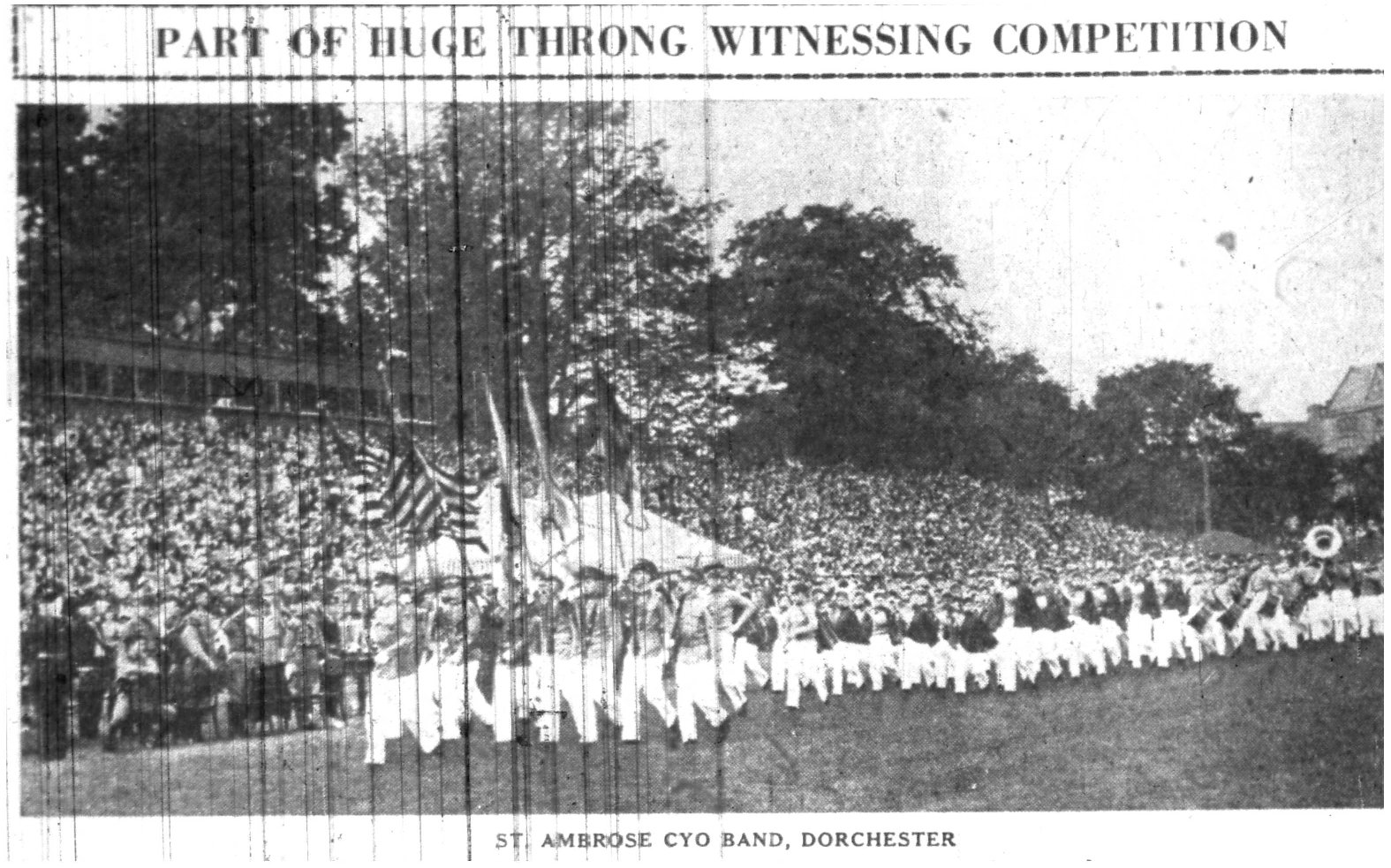
St Ambrose of Dorchester Field Band 1942


The 1940s start with an expanded field of 49 units. Based on the corps names, it appears as if 1940 was the first year that drum and bugle corps were finally sorted out from fife drum and bugle corps. This is also the first year that drum and trumpet corps got their own division. Again, like fiield bands,  I can find no reference to trumpet and drum corps on the Internet. Did they consist of only  drums and trumpets, or were they brass bands with no woodwinds?

1941 was another big year, with 13 bands in three classes, two field bands, five drum and trumpet corps, 9 fife drum and bugle corps in two classes, and 20 drum and bugle corps. The following year was the first war year, Perhaps because of that, 13 few units entered the contest. This was the first year of a dedicated girl’s division, although girls would be back to competing against boys before they were put their own division again. I’ll mention here for the first time that the shows were four minutes long, with units scheduled to start every five minutes. The American Legion was still taking part in the contest, but the marching judges were officers from the military.

This is as good a place as any to mention color guards. The few photos I found in the Pilot show from no color guard at all (just out of view maybe?) to a row of five flags and two rifles. And although the flags and rifles are carried by boys in what looks like all-boy bands, a photo of St Leonard’s band of the North End of Boston seems to show a group of girl baton twirlers marching behind the single flag and rifle line. Baton twirlers were awarded prizes in at least one competition, but they are rarely mentioned otherwise. In any case, it seems as if color guards were just that - an American flag and its ‘guard.’ The day of the bit working color guard with multiple flags, rifles and sabres had not yet come.

Blessed Sacrament Cambridge, the first powerhouse CYO drill team.

The 1943 contest was held at Braves Field. For the first time, four drill teams competed in the event. Also for the first (but not the  only) time, this contest was a non-competitive exhibition. According to an article in the Pilot “We feel that this exhibition will contribute somehow towards relieving the public mind of the anxiety that is constantly present, and will help in building and maintaining morale which is so vital to the war effort.” The following year, competition returned.

In 1946, the contest moved to Manning Bowl in Lynn. Apparently, the CYO was trying to encourage growth in the activity, and took the contest on the road for four years before returning it to Alumni Field at Boston College. I’ll add here that after years of Pilot articles praising Cardinal O’Connell for his generosity in providing the cups for the winners, in 1946 the cups are now the Archbishop Cushing Trophies. As the say, The King is Dead, Long Live the King!.

Quincy Stadium was the location of the 1947 contest. Four units repeated as champions in 1947, and special notice was given to the Cardinal Cushing Cadets of Roxbury, saying that “Tremendous applause, equalling if not exceeding any of the winners, greeted…” them. This was an all-girl drum and bugle corps from a newly founded African-American parish that would go on to win the next seven straight all-girl division trophies.

For some unexplained reason, it was decided to hold a contest at Norwood Arena in 1949, with the winners playing an exhibition at Alumni Field. Even more curious than the decision to make the Alumni Field show a competition is the fact that bands did not take part in the Norwood competition, but did play at Alumni Field. I could find no explanation for this decision.

Looking at the most successful units of the 1940s, Holy Name Band of West Roxbury won four competitions in a row, followed by three in a row by St Joseph’s Band of Medford. St Rita’s Cadets of Lowell won two consecutive Drum and Trumpet Corps trophies, followed by seven straight wins by St Cecelia’s of Ashland. In the Fife Drum and Bugle Corps group St Catherine’s Norwood started the 1940s with four straight wins, with St Mary’s of Dedham following with three wins. Sacred Heart of Malden took seven consecutive Drum and Bugle Corps titles, only losing to Most Precious Blood Crusaders in a head-on-head competition in 1949. And finally, Blessed Sacrament of Cambridge won five of the first six drill team championships.